EN
EN  FI
FI 
LIMITED QUANTITIES, BE HURRY – HEAT PUMPS AT DISCOUNT PRICES!
LIMITED QUANTITIES, BE HURRY – HEAT PUMPS AT DISCOUNT PRICES!
Modern buildings require increasingly intelligent and energy-efficient solutions for indoor climate control. One of the most versatile and effective tools for this is the fan coil unit. Although the term may sound technical, its principle is simple and the benefits are significant – for office productivity, housing company living comfort and home cooling.
Fan coil unit (also fan coil, English: fan coil unit) is a room unit connected to a water circulation system that produces efficient cooling and often also heating. When properly sized and controlled, fan coils are unobtrusive, quiet and very energy efficient. In this guide, we will go through the applications, the most common models and installation methods, the principles of control and sizing, and practical tips for planning your purchase. At the end of the article, you will find a concise FAQ section.
Expert perspective: This guide was written by Renewe Project Manager Ville Nieminen. He has over 15 years of experience in designing and implementing demanding convector and air conditioning systems for data centers, commercial buildings, and industrial processes.
In its simplest form, a fan coil is a device that transfers heat or coolness from water to the room air. A fan coil is part of a water-circulating system, making it a very flexible and energy-efficient solution. Think of it like the heater in your car: it has a water-circulating coil and a quiet fan inside.
The most important thing is to understand that a fan convector does not itself produce heat or cold, but is part of a larger, water-based energy system, and the most efficient partner is often a modern heat pumpThe heart of the fan coil is a heat exchanger consisting of copper pipes and aluminum fins. Water cooler, heat pump, boiler or other heat source produces hot or cold water, which circulates through the convector. A fan directs the room air through the heat exchanger, and the air temperature changes in the desired direction.
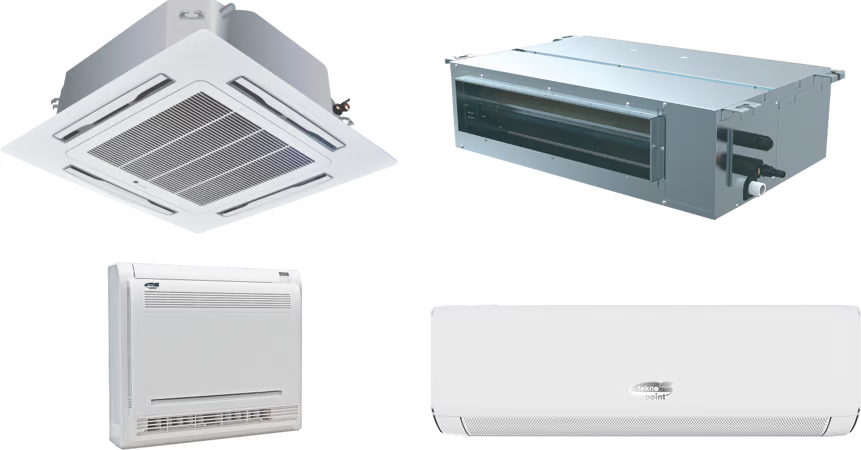
There are several different models of fan convectors available, so there is sure to be a suitable option for every space and need. The most common fan convector models and installation methods;
A familiar and safe choice that resembles the indoor unit of an air source heat pump in appearance. Easy and quick to install, it is ideal for efficient air conditioning of individual rooms, such as bedrooms or offices.
A stylish and elegant solution, typically installed under a window in place of an old radiator. It distributes air pleasantly upwards and is an excellent choice for both homes and representative spaces.
When you want the most discreet solution possible, a ceiling cassette is the first choice. It is installed inside the suspended ceiling, leaving only a stylish grille visible. The cassette blows air in 2 or 4 directions, ensuring a very even distribution of coolness or heat, even in large spaces, such as open-plan offices and shops.
This is a premium choice for aesthetically demanding applications. The entire device is installed concealed in structures such as partition walls or suspended ceilings. Only the air intake and exhaust grilles remain visible, making the technology completely invisible.
The flexibility of fan coil units makes them a great solution for almost any property, with applications ranging from edge to edge;
Fan coils can be used to heat and/or cool an entire building. This is particularly common in new developments and industrial buildings.
A successful fan coil system is more than just the sum of the devices. It is a professionally designed whole. The correct dimensioning, device selection and installation method have a decisive impact on the end result. The power of the devices must match the cooling and heating needs of the space. As a rule of thumb, the cooling need in a modern office is approximately 40–60 W/m², meaning that a 25 m² room requires a convector with an output of approximately 1.0–1.5 kW. Over- or under-dimensioning leads to inefficiency and unnecessary costs, so the final dimensioning is always the responsibility of a professional.
Condensation water removal: During cooling operation, moisture condenses in the device, which must be properly drained. This always requires professional installation.
Convector sizing: The power of the equipment must match the cooling and heating needs of the space. Over- or under-sizing leads to inefficiency and unnecessary costs.
Sound level: Especially in hotels, bedrooms and offices, silence is key. Many modern, high-quality models are almost silent.
Control system: How are the devices controlled? Is there a need to connect them to a larger building automation system (BMS), 0-10v or something else?
Eurovent certification: By ensuring that the selected equipment is Eurovent certified, you can be sure that the technical values (such as power and sound level) declared by the manufacturer are independently tested and accurate. This is often a guarantee of quality and reliability in professional projects.
The price of a fan coil system is affected by many factors, such as the number of devices, the models selected, the power, the scope of the control system and the complexity of the installation work. The price of a single convector can vary from a few hundred euros to thousands of euros, depending on the model and features.
More important than the price of a single device, however, is the total cost of ownership (TCO). A high-quality, properly sized system combined with an energy-efficient heat pump will pay for itself in lower operating costs.
The cost of the investment typically consists of:
At Renewe, we help you understand the total costs and find a cost-effective solution that fits your budget and needs.
At Renewe, we don't just sell individual devices - we deliver comprehensive, smart energy solutions. We know the market's leading manufacturers and their products, so we can always design and implement the most cost-effective solution for your property's needs.
A fan coil unit is at its best when it is integrated into a modern heat pump system. For example, when geothermal energy– or air-water heat pump produces almost free cooling (so-called ground cooling) or active cooling in the summer, a fan coil is by far the most efficient way to transfer this coolness indoors, free cooling of water coolers is also a perfect companion for convectors. In the winter, the same system produces inexpensive heat.
The combination of these systems is the best way to utilize renewable energy: maximum comfort, minimal operating costs and a small carbon footprint. Our experts can design and dimension a system that is right for your property, ensuring the best possible end result.
A fan coil unit is a modern, flexible and highly energy-efficient solution for heating and cooling a property. It offers fast response and improved indoor air quality, and its different models are suitable for a wide range of spaces and needs. Combined with a heat pump, it is a smart investment that pays for itself in lower energy costs and an improved quality of life.
Is it time to update or design your property's heating or cooling system? Would you like to hear more about how fan coils could solve the challenges of your premises? We can help – get in touch.
Book a free design survey: 010 660 3030 | info@renewe.fi | Fill out the form online
What is the difference between a fan coil unit and a fan coil unit?
It's the same device: fan coil = fan coil. The former emphasizes the role of the fan, the latter the structure of the coil/cell.
Which model is the quietest hotel room for destinations?
Typically quiet are floor/duct models and low-noise versions with EC fans and precisely directed air distribution. Check the sound pressure levels (dB(A)) at different fan speeds.
What accessories do I need?
Typical options include 2/3-way valves, room controllers/thermostats, additional air filters, condensate pump, condensation insulation, controls and BMS interfaces. The choice depends on the project.
What is the difference between a 2-pipe and a 4-pipe system?
This is a key choice, especially for large properties. In a 2-pipe system, the same pair of pipes handles either heating or cooling, and the entire system is centrally switched according to the seasons. A 4-pipe system allows simultaneous heating and cooling in different rooms. It is ideal for offices and hotels, for example, where one side of the building may need cooling due to sunlight, while the other side requires heating.
Can the convector be hidden from view?
Yes. The ceiling cassette or duct model can be embedded in the suspended ceiling. The design takes into account maintainability, condensate removal and even air distribution.
Does a fan coil unit help with humidity control?
Yes. In cooling mode, the cell condenses moisture from the air and removes it through the condensation water system, making the indoor air more comfortable.
What is the difference between a fan coil unit and an air source heat pump?
The biggest difference is in the source of heat/coolness. Air source heat pump transfers energy from the outside air and uses a refrigerant. A fan coil is part of a water-circulating system (e.g. geothermal) where energy is transferred by water. A fan coil is therefore only an indoor unit, while an air source heat pump is a complete system.