EN
EN  FI
FI 
LIMITED QUANTITIES, BE HURRY – HEAT PUMPS AT DISCOUNT PRICES!
LIMITED QUANTITIES, BE HURRY – HEAT PUMPS AT DISCOUNT PRICES!
The year 2025 is a turning point in the use of solar energy. Technological advances, economic incentives and a revolution in the energy market have fundamentally changed the nature of a solar panel system. It is no longer just a passive means of reducing the electricity bill, but an active economic asset that generates income, improves property value and provides protection against fluctuations in electricity prices. This guide provides a comprehensive analysis of why investing in solar energy in 2025 is a strategically sound decision for businesses, households and housing associations.
This section examines the key economic drivers that make solar energy an exceptionally attractive investment. We review government subsidies and tax breaks, explore the mechanisms for selling surplus electricity, and present advanced financial metrics that will help companies make informed, long-term decisions. In 2025 solar power plant is no longer just a piece of equipment on the roof – it is a smart part of property management and a gateway to energy self-sufficiency.
Expert views: This comprehensive guide has been written by Renewe's leading energy experts, Mika Aaltonen and Ville Nieminen. With over 20 years of experience in renewable energy solutions, they ensure that you receive the most reliable and up-to-date information about the possibilities of solar energy.
Government financial incentives are a significant factor in accelerating the payback of a solar energy investment and improving its overall profitability. In 2025, these forms of support are tailored to different target groups, and their effective utilization is an essential part of a successful project.
One of the most significant individual incentives for households is the household deduction, which is a tax relief, see tax.fiIt is essential to understand that the deduction applies specifically to the installation work of the solar panel system, not the price of the equipment or materials. This makes using a professional installation service not only a safety and quality issue, but also very profitable financially.
In 2025, the maximum household deduction is EUR 1,600 per person, and the deductible is EUR 150 per year. Spouses can use the deduction separately, which increases the total maximum deduction to EUR 3,200.
Concrete example: Let's assume that a household invests in a solar power system worth 12,000 euros, with installation work costing 4,000 euros. In 2025, the household can deduct 35 % of the work cost in its tax return, exceeding the 150 euros deductible. The calculation is as follows: (4000€×0.35)−150€=1250€. If two adults in the same household apply for the deduction, the total deduction can be up to 2,500 euros. Remember that you can take advantage of the household deduction for the installation work, which can shorten the payback period significantly – even by a year or two!.
The Housing Finance and Development Centre (ARA) offers energy subsidies to housing companies for renovation projects that improve the energy efficiency of the building. Although the previous subsidy, specifically aimed at electric car charging infrastructure, has ended, installing a solar power system is a key measure that improves the energy efficiency class (E-class) of the property and thus qualifies for a general energy subsidy.
Receiving a grant requires energy efficiency calculations prepared by a professional that show the achievable improvement in the E-factor. This highlights the importance of a knowledgeable partner like Renewe in the planning and implementation of the project. The ARA grant can cover a significant part of the investment costs, making even large-scale solar energy projects very economically viable and significantly improving the project's return.
A modern solar power plant not only produces electricity for its own use, but is also a production facility that can actively generate revenue by selling surplus energy to the national grid. This is made possible by two key mechanisms: netting and spot price sales.
Hourly rate and Quarterly netting)The netting model for electricity metering used in Finland is one of the cornerstones of the profitability of solar energy. Hourly netting, which has now moved to increasingly precise 15-minute intervals (quarter-hour), means that the electricity produced and consumed during the same measurement period cancel each other out. Only the difference between these – either additional electricity purchased from the grid or surplus sold to the grid – is registered on the electricity meter.
This mechanism maximizes the value of your self-generated solar electricity. Every kilowatt-hour you generate and consume in the same 15-minute period is a kilowatt-hour for which you do not have to pay any transmission fees or electricity tax in addition to the energy price. This makes your own consumption significantly more valuable than the income from electricity sold to the grid.
All energy that is not consumed during its own measurement period is automatically sold to the electricity grid at the current hourly spot price determined by the Nordic power exchange (Nord Pool). This is where a significant strategic advantage lies. Solar power plant production is at its highest on sunny and warm days – precisely when electricity demand is also often high, for example due to the need to cool buildings. This supply and demand dynamic can drive up spot prices precisely during the hours when surplus production is most abundant.
This natural synergy means that selling surplus power at the spot price is most profitable on sunny days when electricity prices are already high, creating a highly profitable source of income for the solar power plant owner.
Although payback period is a common and easy-to-understand metric, companies need a deeper analysis in strategic decision-making. Here, the life cycle cost of energy production (Levelized Cost of Energy, LCOE) becomes key.
LCOE is the ultimate metric for evaluating long-term energy investments. It calculates the average cost of each unit of electricity produced (e.g., cents per kilowatt-hour) over the entire life cycle of the system. The calculation takes into account all costs: initial investment, financing costs, maintenance, and potential equipment replacements.
Unlike a simple payback period, LCOE allows for a real, comparable analysis between the cost of producing your own solar power plant and the price of electricity purchased from the grid. For a company, this provides a solid basis for strategic decisions, demonstrating the competitiveness of solar energy and its role in controlling costs and increasing predictability in the long term.
This table summarizes the key economic drivers for different target groups, helping to visualize how the value of solar energy is realized in each segment.
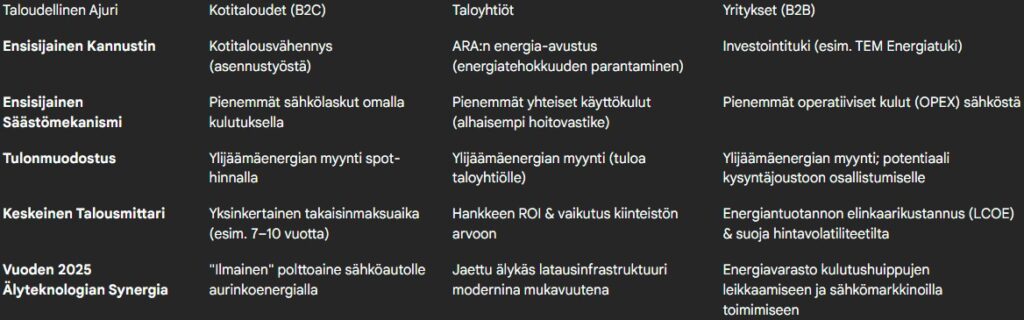
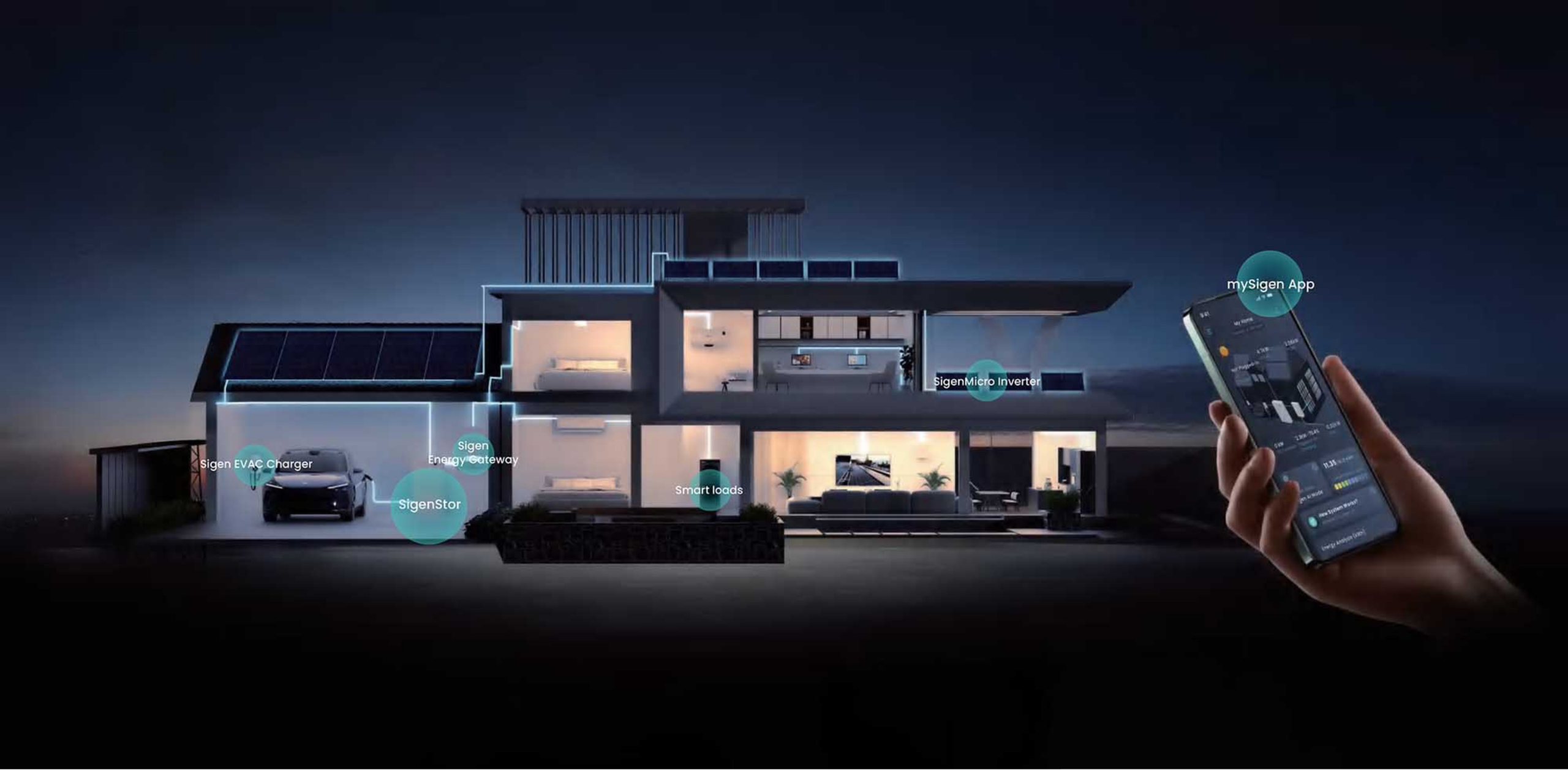
In 2025, we will finally move from separate energy solutions to an integrated and intelligent energy ecosystem. The property is no longer just an energy consumer, but a smart hub where solar energy production, electric car charging, charging stations and energy storage systems work seamlessly together. This whole thing is controlled by intelligent software that optimizes energy use, minimizes costs, and maximizes self-sufficiency. This is the reality of 2025 and the standard of the future.
The rise of electric vehicles is one of the biggest drivers of solar energy demand. The combination of your own solar power plant and an electric car offers the opportunity to drive on practically free, emission-free energy. The efficient operation of this ecosystem is based on dynamic load management.
Dynamic load management is the brain of the system. It measures the property's electricity consumption in real time and automatically adjusts the charging power. When the sun is shining and other consumption is low, your car is charged at full power with free solar electricity. When you start a sauna or an industrial production line, the system temporarily reduces the charging power to prevent the main fuse from overloading. This ensures that you can always charge your car as quickly and safely as possible with your own production, maximizing savings without expensive electricity connection upgrades.
This technology is a huge selling point, offering electric car drivers not only significant cost savings, but also exceptional convenience and peace of mind.
Energy reserves, i.e. batteries, have evolved from mere solar power storage devices into smart tools that actively operate in the electricity market and generate value year-round.
A modern battery does not just store solar electricity generated during the day for use in the evening. It is a smart energy storage system that can be programmed to buy electricity from the grid when the exchange rate is cheapest (e.g. at night), and use or even sell it back to the grid during expensive peak hours. This operation in the electricity market, or arbitrage, makes the battery profitable even in winter, when solar production is low. The battery thus becomes a year-round economic tool that actively optimizes energy costs.
Additionally, energy storage owners can participate in the national reserve market, where the transmission system operator pays compensation for keeping the storage capacity on standby to balance the network frequency. This creates a completely new, passive source of income that further improves the payback period and profitability of the investment.
The development of the energy system does not stop here. The next big step is the integration of electric vehicle batteries into the energy system of buildings and the entire electricity grid.
Renewe expert comment: “According to our Chief Development and Technology Officer Mika Aaltonen, ‘We don’t just install solar panels; we build future-proof energy hubs. V2G/V2H readiness means that your electric car battery will soon become an integral part of your property’s energy storage. This vision shows that Renewe is on the crest of the energy revolution.’”
In 2025, this technology is still in its development phase, but its principles are clear. Vehicle-to-Home (V2H) allows the use of a car's battery as a backup power source for a home during a power outage. Vehicle-to-Grid (V2G) allows a car to feed electricity back into the national grid and contribute to balancing the grid, generating income for its owner. Although V2G-compatible chargers and standards are only just becoming more common, it is important to choose a system that is ready for the possibilities of the future.
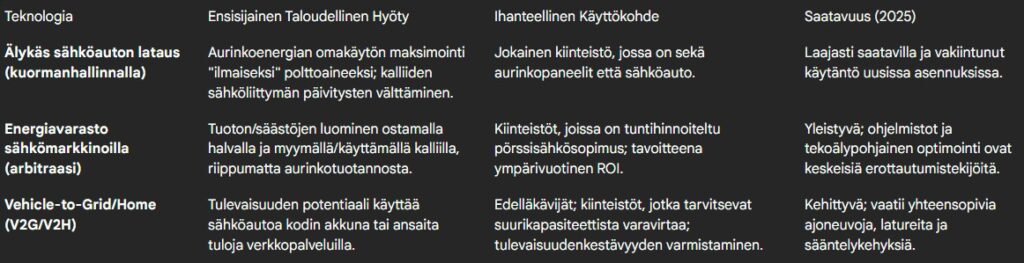
Comparison of smart energy technologies
This table clarifies the role, benefits, and availability of different smart technologies, helping to understand the different levels of the modern energy ecosystem.
Solar energy technologies and economic models offer enormous opportunities, but their effective exploitation requires a tailored approach. The needs, objectives and economic drivers of a business, a household and a housing association are fundamentally different. This section applies the concepts presented earlier to each target group, showing how strategic planning leads to optimal outcomes.
For companies, investing in solar energy is a strategic decision that affects cost structure, risk management and brand value. It's not just about savings, but about building a competitive advantage.
Situation: A 5,500 square meter logistics center with the highest electricity consumption during the day (lighting, sorting equipment, charging electric forklifts). The company suffered from high electricity costs and the unpredictability of electricity prices.
Solution: A 500 kWp solar power plant was installed on the roof of the property. The investment decision was based on an LCOE calculation, which showed that in-house production would be more cost-effective in the long term than a long-term, fixed-price grid electricity contract.
Score: The system covers approximately 35 % of the property's annual electricity consumption. Most of the production is used immediately for its own processes, significantly reducing the amount of electricity purchased from the grid. The payback period for the investment, taking into account the reduced energy costs and improved ESG profile, was estimated at 7 years.
For households, solar energy offers tangible and immediate benefits that improve the quality of everyday life and reduce living costs. Motivators are often both financial and practical.
In housing associations, solar energy is a joint project that requires careful planning and clear communication, but offers significant benefits to all shareholders.
The performance and reliability of a solar energy system is based on the quality of its components and proper design. Renewe is committed to using only high-quality components that have been tested and are suitable for the demanding conditions of the Nordic region. This section takes a closer look at the technical choices that ensure the long service life and maximum yield of the system.
Solar panel technology has advanced by leaps and bounds. This year, the market is dominated by new generation technologies that offer better performance and durability.
N-type cell technologies, such as TOPCon (Tunnel Oxide Passivated Contact) and HJT (Heterojunction), are replacing older P-type PERC panels. The advantages of N-type cells include:
Bifacial panels are able to generate electricity from both sides. They utilize not only direct sunlight but also light reflected from the ground or roof (albedo). This technology is particularly efficient:
In glass-to-glass construction, the traditional plastic backing film is replaced with a second layer of glass. This construction offers superior durability and protection:
The inverter is the heart of a solar power plant, converting the direct current (DC) generated by the panels into alternating current (AC) used by the property and the electrical grid. The choice of inverter technology affects the performance, flexibility and safety of the system.
Our experts always design the best inverter solution for the site, ensuring maximum yield and reliability.
Safety is paramount in photovoltaic systems. High voltage direct current (DC) can cause arcing faults, which are a significant fire risk. Modern systems that use module-level power electronics (microinverters or power optimizers) inherently eliminate this risk. They operate at low voltage and include a built-in Rapid Shutdown function. This means that in the event of an emergency or power outage, the voltage on the panels and cables drops to a safe level within seconds, ensuring the safety of residents and emergency personnel.
A solar system is a long-term investment, and it is protected by comprehensive warranties provided by manufacturers. It is important to understand the difference between the two main types of warranties.
Renewe only selects components whose manufacturers offer market-leading, comprehensive and reliable warranty terms, ensuring our customers' peace of mind for decades.
We make the solar energy transition easy and profitable.
Join the pioneers of sustainable energy – we take care of the design, permitting process and installation. 🔗 Start with a free survey • 📞 010 660 3030 • 📧 info@renewe.fi
In this section, we answer the most common questions our customers ask about solar energy systems.
Production naturally stops temporarily when the panels are under a thick layer of snow. However, it is good to remember a few things: First, the amount of sunlight is low during the Finnish winter months, so winter production is only a small part of the entire year's production in any case. Second, the dark surface of the panels and the small amount of waste heat they produce help the snow to melt and run off. Snow from steeper roofs often comes off on its own during the first sunny days. It is not recommended to clean the panels yourself due to the risk of scratching, as nature usually takes care of this effectively.
The panels we select, especially the glass-on-glass models, are designed and tested to withstand extreme weather conditions. They are certified to withstand impacts from hailstorms significantly larger than those typically encountered in Finland. The use of tempered glass on both sides provides exceptional mechanical strength, ensuring that your investment is protected.
Solar power systems are remarkably low maintenance. The most important task is to keep the panels relatively clean, which is usually done by rainwater. The system has no moving parts, which increases its reliability. We recommend a professional inspection every few years to ensure that all components and connections are in optimal condition.
Solar panels are built to last, with performance guarantees typically guaranteeing production for 25-30 years. Inverters have shorter lifespans; string inverters often have a 10-12 year warranty, while microinverters typically have a 8-15 year warranty. Our system design takes these life cycles into account to give you a clear picture of the long-term total cost of your investment.
Yes, absolutely. When your solar power plant produces more electricity than you consume, the excess electricity is automatically transferred to the national grid, and your own electricity company compensates you for it according to your small-scale production agreement. This significantly improves the profitability of the system.
In most cases, solar panels installed on the roofs of properties do not require a building permit, but in some localities a permit or notification to the municipality may be required. Requirements vary by municipality, so it is always a good idea to check with the local building control before starting the project. You can also read the instructions Energy Agency on the pages.