EN
EN  FI
FI 
LIMITED QUANTITIES, BE HURRY – HEAT PUMPS AT DISCOUNT PRICES!
LIMITED QUANTITIES, BE HURRY – HEAT PUMPS AT DISCOUNT PRICES!
In this in-depth guide, we not only present an alternative, but also provide a strategic solution that will allow you to modernize your property's heating, produce hot water efficiently, and even halve your annual energy costs.
We have previously covered heat pumpIn our guide, we have created an overview of modern heating technologies. Now it is time to delve into a solution that has taken center stage in the Finnish energy renovation market: the air-to-water heat pump (AHP). If air source heat pump is an ingenious backup heater, an air-to-water heat pump is a full-fledged main heating system that not only heats the entire property, but also produces all the hot water needed.
This guide is specifically aimed at those of you who live in a detached house or are responsible for the heating solutions of a company or housing association and whose system is based on water-circulating radiators or underfloor heating. We will go through why air-water heat pump is often an economically and technically superior successor to an old oil, electric or wood boiler and how it frees you from the price fluctuations of fossil fuels.
Expert perspective: This article was written by Renewe's leading renovation expert Jukka Poikela, who has over 15 years of experience in heat pump technology. He specializes in demanding heating system renovations and has seen through thousands of projects how a properly sized air-to-water heat pump is one of the most effective ways to break away from fossil fuels and take control of your energy costs.
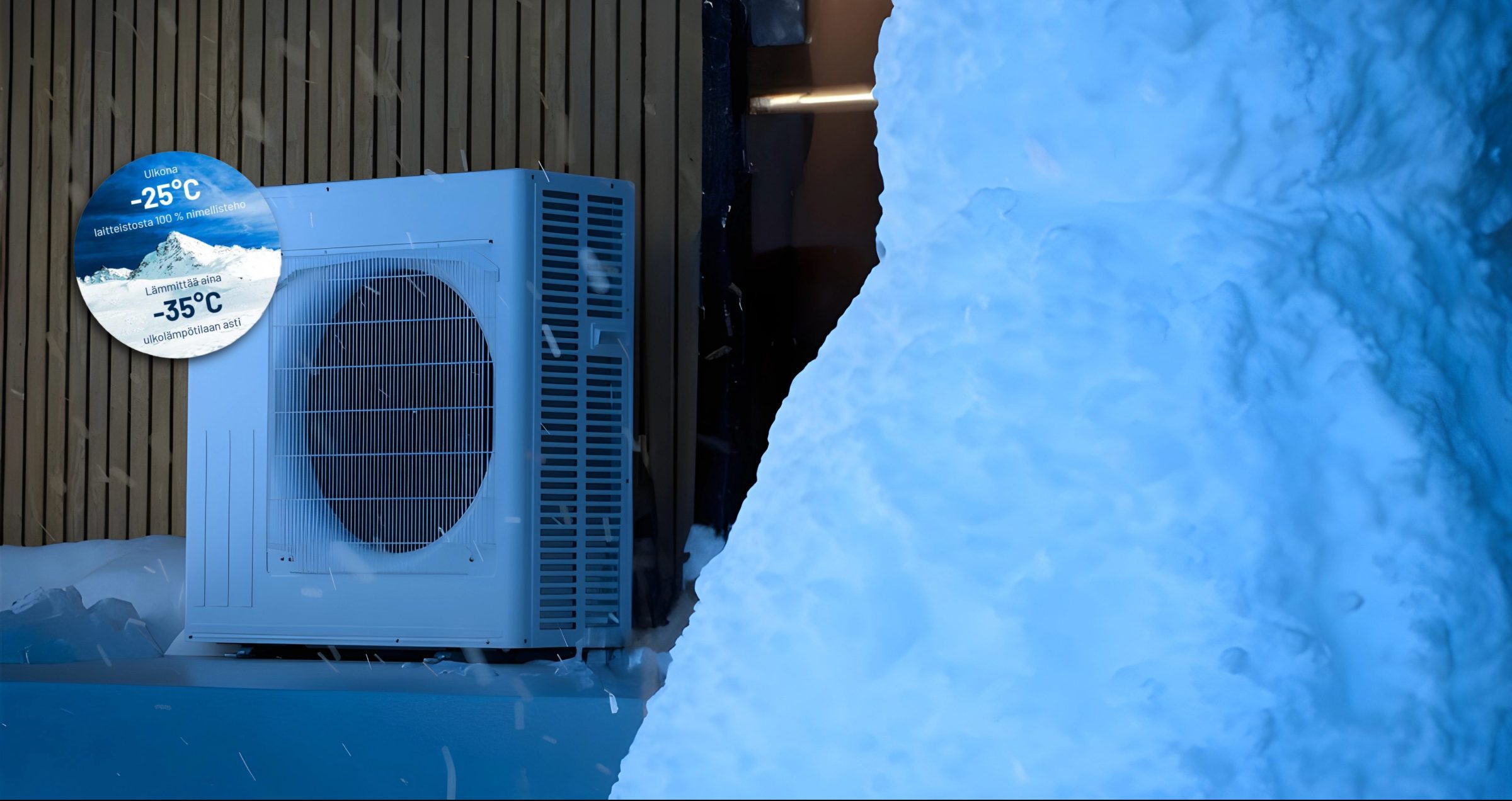
The operating logic of an air-to-water heat pump is the same as that of other heat pumps: it does not create energy, but transfers it. The outdoor unit efficiently collects thermal energy from the outside air, even in severe frosts. This energy is transferred to a higher temperature by means of a compressor and transmitted to the indoor unit.
This is the crucial difference from, for example, an air-source heat pump. Instead of blowing heat into the indoor air, it is transferred via a heat exchanger to the property's existing water-circulating heating system - i.e. to radiators or underfloor heating pipes. At the same time, the system heats the domestic water in an integrated tank or a separate tank, which you use in the shower and taps, if necessary. It therefore completely replaces the tasks of the old heating boiler, but does so 3–5 times more energy-efficiently.
Purchasing an air-to-water heat pump is not a small upgrade, but a strategic decision that will change the fundamentals of your property's energy management. Its economic superiority is based on two key factors.
First, it cuts direct heating costs dramatically. When switching from an old oil or electric boiler to a modern air-to-water heat pump, annual heating costs are reduced by an average of 40–70 %. This means annual savings of thousands of euros in a typical detached house, making the investment very profitable, and savings of tens of thousands in industrial properties. The payback period is often only 5–8 years, after which the device produces pure savings throughout its entire life cycle.
Secondly, it frees you from the volatile global market price of fossil fuels. The price of oil can fluctuate greatly due to political decisions or global crises. An air-to-water heat pump uses only electricity, the production of which you can further enhance, for example, by using your own solar power plant, achieving significant energy self-sufficiency. It is an investment in stability and predictability.
Although the technology is flexible, there are clear locations where an air-to-water heat pump is almost invariably the best choice for energy renovation.
Single-family and semi-detached houses with oil or electric heating are the core market for air-to-water heat pumps. If your property has a water-based heat distribution system (radiators or underfloor heating), VILP is often the most cost-effective and technically straightforward way to modernize the system, get rid of the old oil tank and move into the era of renewable energy.
New buildings, where it is not possible or economically sensible to drill a geothermal well due to the characteristics of the plot, are another key target group. An air-to-water heat pump offers almost the same efficiency and comfort as geothermal heat without expensive and permit-required earthmoving work.
Housing companies, especially townhouses and smaller apartment buildings, can utilize air-to-water heat pumps either as a centralized system or as apartment-specific solutions. They are an excellent option when you want to upgrade an outdated heating system to a modern one and improve the energy performance of the property.
For companies, An air-to-water heat pump offers several significant advantages. Firstly, it is a cost-effective solution that can significantly reduce energy costs, especially in large properties. Air-to-water heat pumps are also very flexible and well suited to different types of buildings, making them an excellent choice for both small and large businesses. Furthermore, air-to-water heat pumps are an environmentally friendly choice, as they reduce the company's carbon footprint. This not only improves the company's environmental image, but can also attract environmentally conscious customers and investors.
Monobloc: compressor and heat exchanger in the outdoor unit, water circulates outside → requires antifreeze protection (usually glycol).
Split: refrigerant circulates outside and inside, heat exchange in the indoor unit → no glycol, piping with refrigerant (authorized installation only).
Hydrosplit: manufacturer-specific intermediate model; water circulation, but frost protection implemented with the manufacturer's solution.
The choice is made based on the risk of frost, piping distances, facilities and maintenance preferences.
How to integrate VILP into a property;
– Tank: domestic hot water tank (additional heating if necessary) and/or buffer tank for the heating circuit to balance the compressor operation.
– Distribution methods: radiators, underfloor heating or mixed system; shunt and pumps are sized for the flows.
– 3-way valve: directs heat alternately to domestic hot water and heating according to priority.
– Adjustments: adjustment curve according to outdoor temperature; separate temperature for domestic hot water and possible hot water boost.
Buyer's quick checklist;
– Architecture: monobloc / split / hydrosplit
– Power dimensioning, electrical power and bivalence point
– Accumulator/buffer tank, 3-way valve, mixing valve
– Supply water demand (radiators/floor), control curve
– Placement: outdoor unit platform, defrost water control, noise
– Control: exchange-based electricity, solar power, data log
– Warranty, maintenance, spare parts and remote support
– Support forms and household deduction: check the current conditions, we will help you with your search
The government strongly supports the transition away from oil heating. Individuals and municipalities can apply for energy renovation either ELY Centre grant to give up oil or gas heating or take advantage of a significant reduction in the installation cost household deduction, (-35 – -60%, 2025). These subsidies significantly reduce the initial investment and accelerate its payback period even further. Our experts will always help you find the best form of support and assist you in applying for it.
In industrial properties, air-to-water heat pumps are particularly profitable in 500-5000m² areas where geothermal investment would be prohibitive. Cascade-connected VILP units achieve up to 500 kW of heating output, and the investment is 30-50% cheaper than a comparable geothermal solution. Peak power cut significantly reduces the basic district heating charges.
In housing companies, terraced house-type properties benefit the most. A centralized VILP system in a terraced house with 8-12 apartments costs €40,000-60,000, while apartment-specific solutions would cost €80,000-100,000. The energy certificate typically improves from class D to class B, which increases the value of the apartments by a conservative estimate of 3-6%. The credit calculation procedure enables equal distribution of heating costs.
In commercial and office buildings, VILP integrates seamlessly with building automation. Zone control enables different temperatures in different rooms, and the cooling function replaces separate air conditioning. A typical 1000m² office building saves €15,000-25,000 per year compared to oil heating.
Renewe's experts will assist you in all phases of the project – from thorough mapping and planning to professional installation and maintenance.
Book a free survey: 010 660 3030 | info@renewe.fi | fill out the form online
Does an air-to-water heat pump work reliably in the coldest temperatures? Yes. High-quality air-to-water heat pumps designed for Nordic conditions operate reliably and produce heat even in very cold weather. However, the efficiency of the system decreases as the air gets colder, which is why almost all of the systems we install include an electric heater. This heater automatically switches on on the coldest days, ensuring that your property stays warm and there is enough hot water regardless of the weather. So you will never be left cold.
Is an air-to-water heat pump suitable for an old property with radiators that require high temperatures? Yes, modern technology has solved this challenge. Although air-to-water heat pumps are most effective with low-temperature underfloor heating, the new generation of high-temperature models can produce water at up to +70 degrees. This is also excellent for heating older, single-plate radiators, so expensive radiator repairs are usually not needed. However, professional sizing is key to success.
What is the main difference between an air-to-water heat pump and a ground source heat pump and why would I choose VILP? Both are excellent systems. Geothermal energy takes its energy from the ground, which has a constant temperature all year round, making it slightly more energy efficient and stable in extreme cold. An air-to-water heat pump takes its energy from the outside air. The biggest difference is in the investment and installation: an air-to-water heat pump does not require expensive and licensed drilling of a heat well, which is why its initial investment is typically 10,000–15,000 euros cheaper. It is worth making this choice if your plot is not suitable for drilling or if you want to achieve the benefits of almost geothermal heat with a significantly lighter initial investment.
Can VILP be connected to an existing oil or electric boiler for hybrid use? Yes, this is an excellent option for a phased transition. VILP takes care of the main heating for 70-80% of the year, the old boiler acts as a backup and peak heater in severe frosts. This reduces consumption by about 60-80% and allows the old boiler to be removed later. Hybrid operation makes sense especially if the oil boiler is still in good condition or the need for peak power is particularly high.
How do I maintain the system? As the user, you keep the filters and ventilation clear, check for leaks, and monitor alarms. A professional will perform regular maintenance according to the manufacturer's instructions.
Did you know? An air-to-water heat pump can also cool a property in the summer, e.g. with fan coils.