EN
EN  FI
FI 
LIMITED QUANTITIES, BE HURRY – HEAT PUMPS AT DISCOUNT PRICES!
LIMITED QUANTITIES, BE HURRY – HEAT PUMPS AT DISCOUNT PRICES!
We have met before. solar energy as a whole and panel technology Now it's time to move on to the invisible but absolutely critical hero of the system: the inverter. If solar panels are the muscles of the power plant that collect power, the inverter is its smart brain. It not only converts the direct current (DC) produced by the panels into alternating current (AC) used by the property and the electrical grid, but it also controls, optimizes and monitors the operation of the entire system.
InverterThe quality and technology choice of your system directly affect how much electricity your system produces, how reliably it operates, and how long it lasts. There are two established technological approaches on the market: the traditional, centralized string inverter and the newer, decentralized microinverter system. In this guide, we will go over the operating principles, advantages, and disadvantages of both so you can understand which one is best for you. your solar power plant.
Expert perspective: The technical content of this article is written by Renewe's Design Manager Mika Aaltonen. His over 15 years of experience in demanding electrical and energy systems has shown that a properly selected and sized inverter is an absolute prerequisite for a reliable and efficient solar power plant.
Microinverters represent a decentralized and panel-specific approach. As the name suggests, a microinverter is a small device that is installed one per solar panel directly on the roof, under the panel. Each panel and microinverter form their own small, independent power plant. They are not in series with each other, but the alternating current they produce is combined and routed directly to the property's electrical center. Fire safety is also in a class of its own with microinverters.
This architecture directly solves the challenges of the string system. Because each panel operates independently, a shadow, dirt or possible technical failure falling on one panel does not affect the operation of the other panels in any way. The system always produces the best possible overall output, as each panel is individually optimized.
This makes microinverters a superior solution for roofs that are challenging, where maximum yield or fire safety are desired: for example, if the panels have to be installed in different directions, at different angles of inclination, or if there are shading elements on the roof such as chimneys, ventilation ducts or nearby trees. In addition, a microinverter system is very easy to expand and maintain in the future; new panels and microinverters can be added to the system one at a time without the need to replace the central unit. The technical service life of microinverters is also significantly longer, often over 20 years, which is close to the lifespan of the panels.
The string inverter (also known as a central inverter or chain inverter) has been the industry standard for photovoltaic systems for decades. Its operating logic is clear: several solar panels are electrically connected in series, forming one or more “strings”. These strings are fed to a single, centralized inverter unit, which is typically installed in a technical room or on an external wall of a building.
This centralized model is a technically mature, reliable and cost-effective solution, especially in sites where conditions are optimal. Such as large, uniform and shadow-free roof surfaces where all panels are in the same direction and tilt angle. When the panels operate identically, the string inverter can efficiently convert the combined production of the entire chain to fit the electricity grid.
The strength of a string inverter is its simplicity. A single device is easy to install and maintain. It typically has a lifespan of 10-15 years, and quality manufacturers offer comprehensive warranties. However, it is essential to understand its biggest challenge, which is the series connection. Like an old-fashioned string of Christmas lights, the entire chain is only as strong as its weakest link. If one panel gets shaded, dirty, or fails, its output will be reduced, affecting the performance of the entire chain and limiting the output of the other panels.
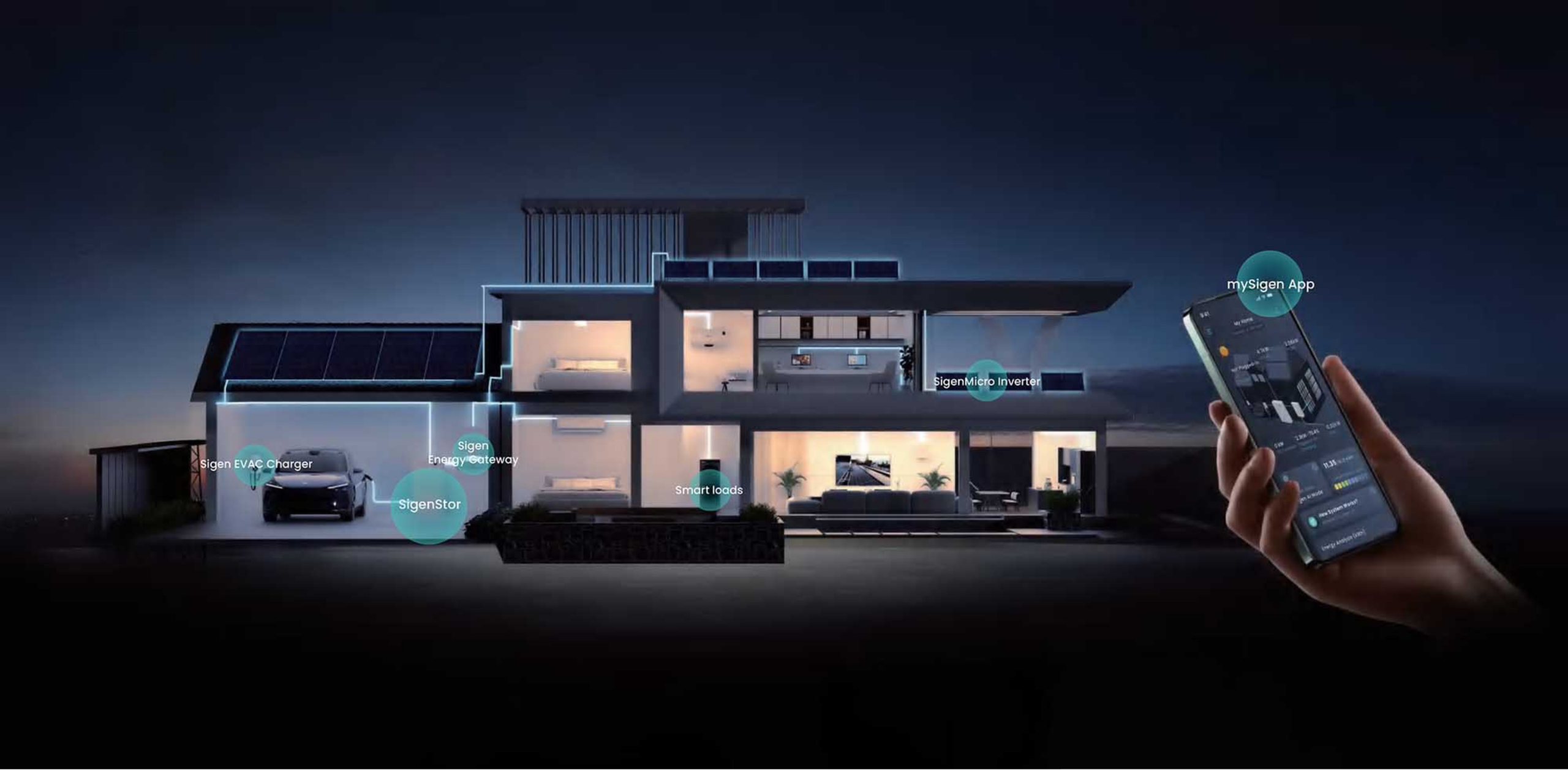
In modern energy system design, the role of the inverter has expanded from a mere power transformer to the intelligent hub of the entire energy system. This is where the hybrid inverter takes center stage. A hybrid inverter is an advanced string inverter with built-in ability to manage and control the energy storage (battery). It acts as a traffic controller, deciding in real time where the energy produced by the solar panels is directed: Directly for consumption by the property. Surplus energy for charging the battery. Energy discharged from the battery for use by the property when the sun is not shining. Surplus energy to the electricity grid when the battery is full and consumption is low. By choosing a hybrid inverter, you ensure that your solar power system is future-proof and ready to be expanded with energy storage, which is the next logical step towards complete energy self-sufficiency.
Companies: In industrial buildings, a string inverter is often the most cost-effective solution for large, unshaded roofs. For 100+ kWp systems, savings can be €5,000-10,000 compared to microinverters. On the other hand, in office buildings with HVAC equipment and shading structures, microinverters can produce 15-25% more annually. Housing companies: In the compensation calculation procedure, the panel-specific monitoring of microinverters facilitates the transparent distribution of production to shareholders. A string inverter requires a separate production distribution measurement. Fire safety is particularly important in apartment buildings – microinverters eliminate the risks of DC cabling, e.g. in stairwells.
There is also a third way that combines features from both worlds. Power optimizers are panel-specific add-ons that are installed in a string inverter system. Like microinverters, they optimize the output of each panel individually, eliminating the weakest link problem. However, the optimized DC power is still fed to a single centralized string inverter for conversion. This solution offers the benefits of panel-specific optimization while maintaining the centralized inverter architecture.
There is no single right answer to choosing an inverter, there is only the most suitable or desired solution for each application.
Choose a traditional string inverter when:
Choose microinverters when:
Choosing the right inverter is critical to your return on investment. It ensures that you get the most out of your panels, no matter what the conditions on your roof are. Expert tip: Don’t compare inverters based on kilowatt (kW) alone. Always ask about features such as the number of MPPT trackers (which gives you flexibility in different directions) and software capabilities. A quality inverter is, above all, an intelligent control center, not just an efficient converter.
Next step? Let us do the analysis for you. Contact our experts, and we will help you analyze your project free of charge and choose the right inverter technology.
Can I track the production of individual solar panels with different inverter types? This is one of the key differences between the systems. With a traditional string inverter, you typically see the total output of your entire solar array as a single number. This means you can’t see how each panel is performing individually. A microinverter system, on the other hand, offers a whole new level of transparency. Because each panel is its own independent unit, you can see the output of each panel in real time via a monitoring app. This makes it easy to detect and immediately locate potential problems, such as dirt accumulating on one panel or a rare technical failure, ensuring the best possible performance of the system throughout its entire life cycle.
Is there a difference in safety between a string inverter and microinverters? Both systems are safe when professionally installed and implemented in accordance with all electrical safety regulations. However, there is a fundamental difference in their electrical architecture. In a string system, the high-voltage direct current (DC) generated by the panels is led from the roof in long cables to a central inverter located inside the building. In a microinverter system, this high-voltage direct current is converted into standard and safer alternating current (AC) right under the panel on the roof. This means that only normal household electricity is carried in the cables coming down from the roof. Many consider this distributed architecture to be an inherently safer solution.
What happens if the inverter fails? How do the systems differ? The effect of a failure is the most significant practical difference between the systems. If a central string inverter fails, the entire solar power plant will cease to produce electricity until the central unit is repaired or replaced. This means that there is a single point of failure in the system. A microinverter system, on the other hand, is more fault-tolerant. If one microinverter fails due to a rare fault, only the individual panel below it will stop producing. All other panels and microinverters will continue to operate as normal. The total production of the system will therefore only decrease slightly, but never stop completely, which ensures greater reliability and continuity of production.
What is a hybrid inverter and when should you consider it? A hybrid inverter is a smart all-in-one solution that combines a solar inverter and an energy storage charging/discharging inverter in the same device. It can control the production of solar panels either for direct consumption, storage in batteries or sale to the grid – fully automatically and with intelligent optimization. A hybrid inverter is an excellent choice if you are planning energy storage either immediately or in the near future. It is more cost-effective than purchasing separate inverters and takes up less space in the technical room. A particularly recommended solution for single-family homes and small businesses that want to maximize the self-use of solar electricity.